
An electronics company
Camera automatic production line
Simple system architecture, low cost, high efficiency, easy maintenance.
Project Overview
This project is a fully automated assembly line for camera products of a leading electronics company, covering the entire process including front cover assembly, light board assembly, lens and mainboard installation, POE board screw fastening, airtightness testing, automatic labeling and marking, and finished product outbound. The production line adopts a modular design and integrates vision guidance, precision fastening, in-line inspection, and data traceability technologies, achieving positioning accuracy of ±0.02mm and repeatability of ±1%, realizing fully automated production from bulk material feeding to finished product output.
Architecture Overview: Four-Layer Intelligent System
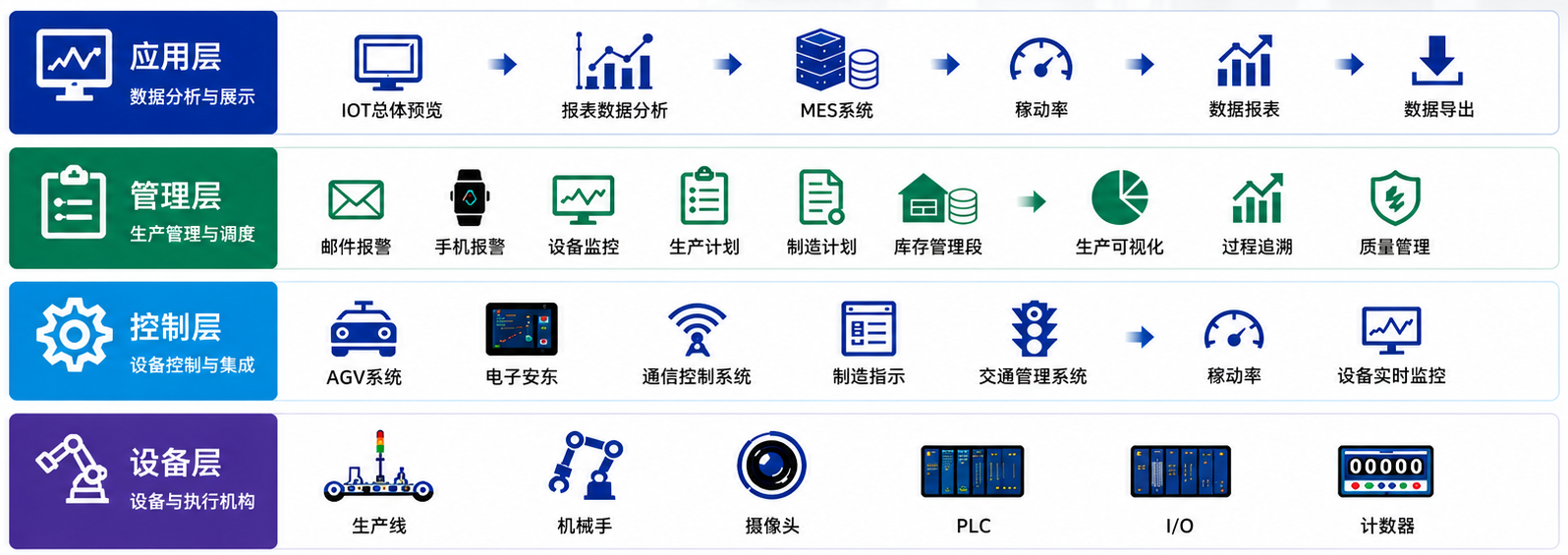
The core of this production line is not just the automation equipment itself, but also the information system support behind it. The entire line adopts the standard Industry 4.0 four-layer architecture, which from bottom to top consists of the Device Layer, Control Layer, Management Layer, and Application Layer.
The Device Layer is the foundation of the production line, including actuators such as the production line, robotic arms, PLC, I/O modules, and counters. The Control Layer is responsible for equipment control and integration, covering functional modules such as AGV scheduling, electronic Andon system, communication control system, and real-time equipment monitoring. The Management Layer focuses on production management and scheduling, implementing core business functions including email/phone alerts, production planning and scheduling, manufacturing instruction issuance, inventory management, process traceability, and quality management. The Application Layer sits at the top, providing data analysis and visualization capabilities for managers, including IoT overall preview, MES system dashboards, report data analysis, and equipment utilization monitoring.
Through the organic integration of these four layers, the production line achieves seamless connectivity from equipment data collection and production process control to management decision support, truly realizing "data-driven production."
Complete Process Flow: A Precision Journey from Bulk Materials to Finished Products
Supported by the four-layer architecture, the production line operates in an orderly manner according to the following process flow.
After the production line starts, front covers are automatically fed through vibratory bowls, and after dust removal, they enter the assembly station; light boards are automatically fed through swing feeders, positioned by a pick-and-rotate mechanism, and then enter the screw fastening preparation. Meanwhile, mainboards are automatically picked by transfer hands, scanned for code recording, dust-removed, and precisely placed under vision guidance. Materials such as lenses and shutter cables are manually loaded in batches to designated stations, and robotic arms automatically complete picking and pre-assembly.
The assembly process is divided into multiple parallel stations operating in coordination. Front covers and middle frames undergo pre-assembly through a dual-module pick-and-place structure, followed by automatic screw fastening of multiple screws at once by a dual-module screw fastening mechanism, with the vision system determining in real time whether any screws are missing. The light board assembly station uses HOIS electric screwdrivers with suction nozzles to complete fastening, with dual-station light-blocking rod assembly and light board screw fastening performed simultaneously. After POE boards are automatically fed, they are connected to the mainboard via dual-head cables, and the system automatically completes three-code association before entering the programming and dispensing processes.
Quality control runs through the entire production line. Each screw is visually confirmed after fastening, and the airtightness testing station automatically performs both positive and negative pressure tests, with defective units automatically triggering alarms and being rejected. After all processes are completed, finished products are automatically conveyed to the labeling station for label printing, application, and outbound. The production line automatically collects and associates data throughout the entire process, forming a complete product profile and achieving "one code per product, full traceability."

Project Results
After delivery, the production line achieved fully automated continuous operation, significantly shortened production cycles, and markedly increased production capacity. The combination of precision assembly and in-line inspection effectively reduced the defect rate, and product consistency was greatly improved. The system supports rapid changeover and can adapt to multiple camera models. Production process data is collected in real time and is traceable, providing data support for process optimization and management decision-making.